|
I. STUDII ȘI CERCETĂRI – ÉTUDES ET RECHERCHES
|
|
|
|
|
|
|
|
|
A. NUMISMATICĂ – NUMISMATIQUE
|
|
|
|
|
|
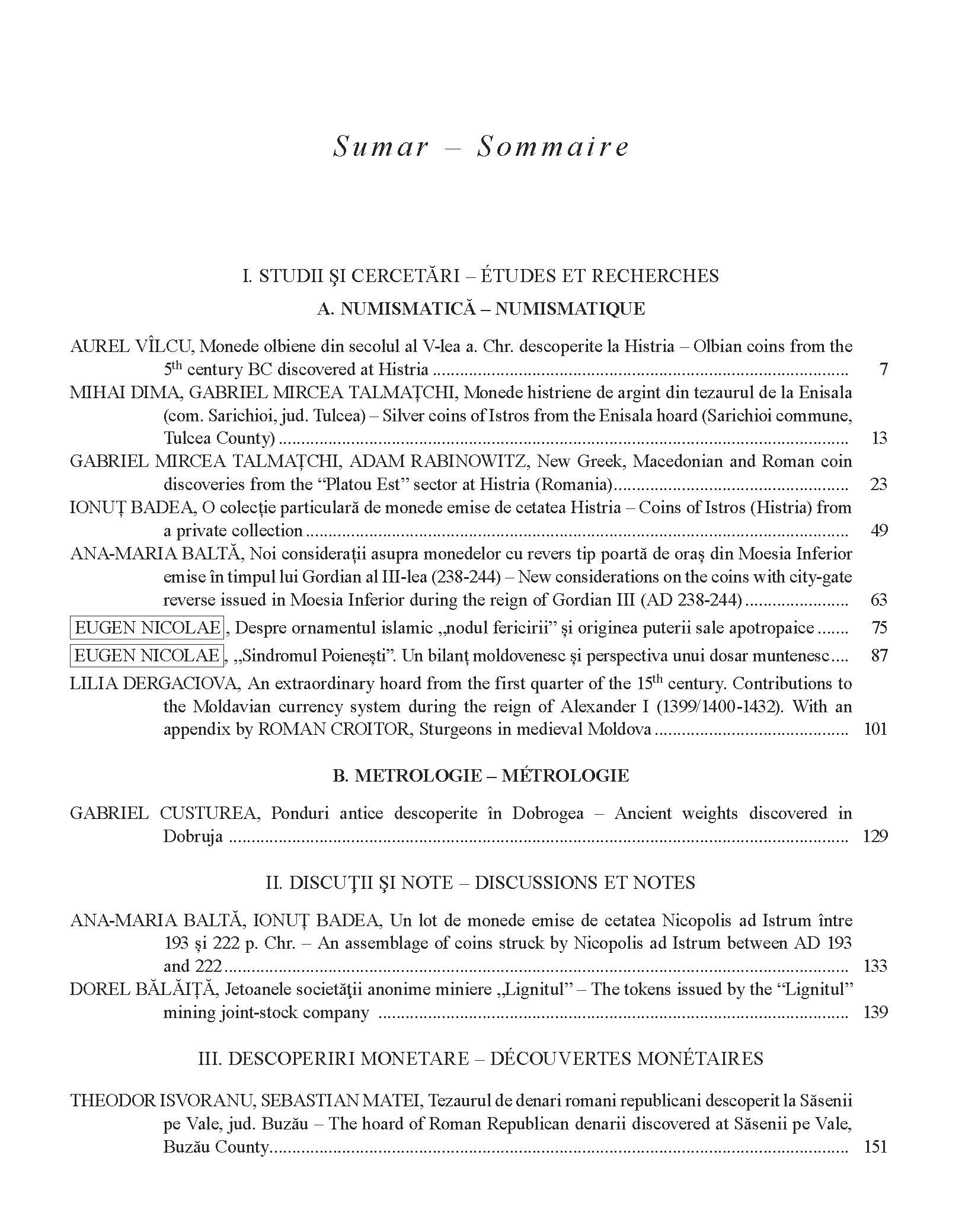
AUREL VÎLCU, Olbian coins from the 5th century BC discovered at Histria
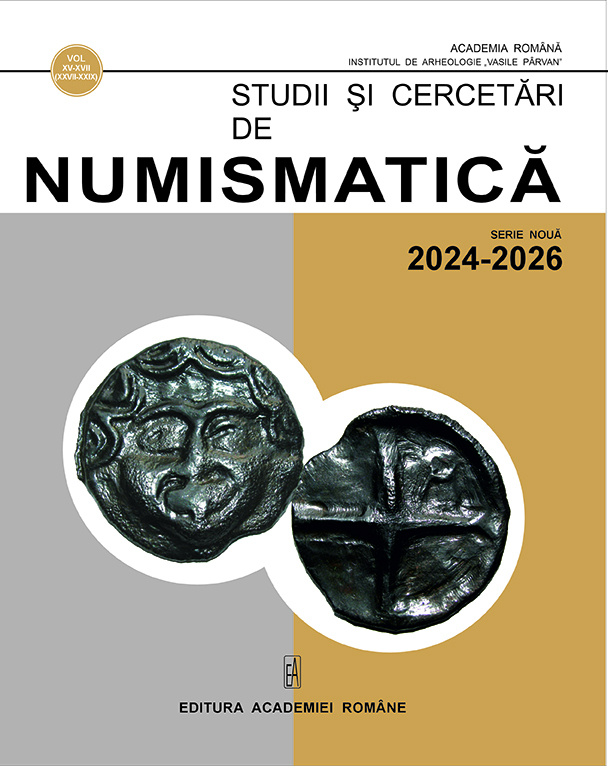
In the year 2003, during archaeological excavations at Histria, two Olbian bronze coins were discovered in a layer with materials dated to the middle of the 5th century BC. Both coins have Medusa’s head on the obverse and the four-spoke wheel accompanied by the legend APIX on the reverse. The finds in Dobruja of Olbian bronze coins minted during the autonomous period are discussed. Olbian bronze coins are present in Northern Dobruja and in the Greek cities of Istros and Callatis, indicating economic links with the north Pontic city.
|
7
|
|
|
|
|
MIHAI DIMA, GABRIEL MIRCEA TALMAȚCHI, Silver coins of Istros from the Enisala hoard (Sarichioi commune, Tulcea County)
The authors present a batch of 36 silver coins of Istros coming from a hoard discovered in 1973 at Enisala (Sarichioi commune, Tulcea county). The coins are kept in the collection of the Museum of National History and Archaeology in Constanța. The 30 high denomination coins fall into the first three subgroups of Group IV of silver coins issued at Istros (subgroup I 1, subgroup II 5, subgroup III 24). The batch also includes 6 divisionary coins, 2 of which belong to subgroup III of Group IV, the rest being earlier. The Enisala hoard is dated to the end of the 4th century.
|
13
|
|
|
|
|
GABRIEL MIRCEA TALMAȚCHI, ADAM RABINOWITZ, New Greek, Macedonian and Roman coin discoveries from the “Platou Est” sector at Histria (Romania)
|
23
|
|
|
|
|
IONUȚ BADEA, Coins of Istros (Histria) from a private collection
Coin collecting is more than a hobby; it is a journey through history, preserving economic, cultural, and artistic insights. In this article, the author presents a collection of 73 coins issued by the ancient city of Histria, ranging from the earliest emissions (5th Century BC) to the Roman period (3rd Century AD). The collection includes 27 silver and 46 bronze coins, acquired over decades from Dobruja. The silver coins primarily consist of drachmas and subdivisions, some well-preserved, while others show signs of ancient counterfeiting. The bronze coins span both the autonomous and Roman periods, featuring depictions of deities, emperors, and empresses, with a few rare and noteworthy issues. The catalog follows established numismatic conventions, using both traditional and digital identification tools. This collection offers valuable insights into Histria’s numismatic history and its role within broader economic and cultural contexts.
|
49
|
|
|
|
|
ANA-MARIA BALTĂ, New considerations on the coins with city-gate reverse issued in Moesia Inferior during the reign of Gordian III (AD 238-244)
The current study revisits the topic of city gates’ monetary depictions from Moesia Inferior dating to the reign of Gordian III (238-244). Although they have been mentioned in various publications, a comprehensive analysis remains absent. Therefore, our research briefly contours the context of their appearance. Markianopolis could have reflected the reconstruction endeavours of Tullius Menophilus (238-241), which continued earlier initiatives from the final phase of Severus Alexander’s reign (230-235), but also from the period of Maximinus Thrax. The nikopolitan coins might be seen as part of a wider group of monetary depictions linked to the passing of Gordian III through Moesia Inferior in 242 while on road for the Eastern campaign. The second part of the study emphasises a series of stylistic similarities between markianopolitan (pl. I, no. 1, 2, 5) and nikopolitan coins with city-gate reverse (pl. II, no. 5-8). In a preliminary stage, they could be associated with the transfer of a part of Markianopolis’ die-engravers to Nikopolis ad Istrum. Future research would show if this episode is recurring or not, or if there are other implicated cities. Our case highlights the difficult interpretation of stylistic similarities between dies which were not shared by two or more mints, an aspect that remains an open question.
|
63
|
|
|
|
|
EUGEN NICOLAE, Despre ornamentul islamic „nodul fericirii” și originea puterii sale apotropaice
|
75
|
|
|
|
|
EUGEN NICOLAE, „Sindromul Poienești”. Un bilanț moldovenesc și perspectiva unui dosar muntenesc
|
87
|
|
|
|
|
LILIA DERGACIOVA, An extraordinary hoard from the first quarter of the 15th century. Contributions to the Moldavian currency system during the reign of Alexander I (1399/1400-1432). With an appendix by ROMAN CROITOR, Sturgeons in medieval Moldova
|
101
|
|
|
|
|
|
|
|
B. METROLOGIE – MÉTROLOGIE
|
|
|
|
|
|
GABRIEL CUSTUREA, Ancient weights discovered in Dobruja
The author presents a number of ten weights (seven pounds and three counterweights of scales) discovered on the territory of Dobruja in Constanța (1), Izvoarele (3), Târgușor (4) and in unspecified locations (2). They date back to 2nd-3rd and 4th-7th centuries, in the Roman and Roman-Byzantine periods.
|
129
|
|
|
|
|
|
|
|
II. DISCUȚII ȘI NOTE – DISCUSSIONS ET NOTES
|
|
|
|
|
|
ANA-MARIA BALTĂ, IONUȚ BADEA, An assemblage of coins struck by Nicopolis ad Istrum between AD 193 and 222
Authors present a batch of 16 coins from a private collection which were put into circulation by Nicopolis ad Istrum between AD 193 and 222. 11 are assarion coins covering the reign of Septimius Severus (AD 193-211). The other 5 bear the names of provincial governors of Moesia Inferior and were issued for Septimius Severus & Caracalla (1), Iulia Domna (1), Caracalla (1) and Elagabal (2).
|
133
|
|
|
|
|
DOREL BĂLĂIȚĂ, The tokens issued by the “Lignitul” mining joint-stock company
The author presents a brief history of the establishment and functioning of the mining company “Lignitul”. The Romanian joint-stock company “Lignitul” was founded in 1908 and had its headquarters in Bucharest. The company’s purpose was to explore, exploit and commercialize coal from the coal basin of Câmpulung Muscel having several mining concessions in Jidava, Jugur, Poenari, Schitu Golești and Iablanița in Banat. The mining workers from the mines in the area of Câmpulung were brought from Banat. For these workers, residential colonies and canteens were constructed. In these mine canteens, tokens with nominal value were used to pay for the food purchased, serving as a substitute for official currency. A part of the employees’ salaries were paid in such pseudo-currencies which were legal tender only inside the colony and could be used only in the canteens of the “Lignitul” company. Four nominal values are presented: 1 Leu, 2 Lei, 5 Lei and 100 Lei. In 1938, S.A.R. “Lignitul”, together with the company “Schitu Golești”, merged with the company “Concordia” – “Lignitul” Mining Department.
|
139
|
|
|
|
|
|
|
|
III. DESCOPERIRI MONETARE – DÉCOUVERTES MONÉTAIRES
|
|
|
|
|
|
THEODOR ISVORANU, SEBASTIAN MATEI, The hoard of Roman Republican denarii discovered at Săsenii pe Vale, Buzău County
The authors present a coin hoard consisting of 21 Republican Roman denarii including an imitation, which was recently discovered in a forest in the village of Săsenii pe Vale, Buzău County, about 4.5 km southwest of the dava-type settlement of Cârlomănești. The denarii belong to the period 154 (C. Scribonius) – 80 BC (L. Procilius), two-thirds of them dating from the first two decades of the 1st century BC, for which the issues follow one another almost without interruption (except for the years 88 and 87). The core of the hoard consists of denarii from 90-80 BC, the last issues dating from the years of the ascension and dictatorship of L. Cornelius Sulla in Rome. The imitation denarius is a fragmentary piece, torn from antiquity, which reproduces one of the issues of L. Calpurnius Piso Frugi from 90 BC. On several coins there are traces of burning, often severe. In some cases (the imitation piece or the denarius of C. Coelius Caldus) this is probably why the flan has become brittle, favoring the fracturing. On the obverse of two denarii from 120 and 84 BC, incised „control marks” can be observed. As a chronological framework, given that the denarius of L. Procilius provides a terminus post quem in 80 BC and that the last coins are not very worn, we consider it justified to attribute the hoard from Săsenii pe Vale to the first “wave” of massive penetration of denarii into Dacia, conventionally placed in the interval 75-70/65 BC, which would correspond approximately to the last Mithridatic War. Other hoards of Roman Republican denarii discovered in the area end significantly later, towards the end of the Republic and the beginning of the Principate.
|
151
|
|
|
|
|
MIHAI DIMA, GABRIEL MIRCEA TALMAȚCHI, A coin hoard from the middle of the 2nd century A.D. found at Durostorum
The authors present a batch of 43 imperial denarii from the 1st-2nd centuries A.D. found at Ostrov, Constanța county, at Regie point, located a short distance from the Romanian-Bulgarian border crossing point from Ostrov-Silistra. The structure of the batch of denarii recovered from the Ostrov-Regie hoard is as follows: Vespasian 3 specimens, Titus 1 specimen, Domitian 8 specimens, Nerva 2 specimens, Trajan 16 specimens, Hadrian 10 specimens, Antoninus Pius 3 specimens (Diva Faustina 1, Marcus Aurelius Caesar 1). The latest coin was issued in A.D. 155/156. Along with the denarii, four bronze coins were donated to the Museum of National History and Archaeology Constanța, but it is not known whether they were found together with the silver coins. One of these, of Aurelian, belongs to another period, but the other three fall within the chronological range covered by the 43 denarii.
|
163
|
|
|
|
|
MIHAI DIMA, ALIN FRÎNCULEASA, Roman coins found in Urlați, Prahova County
Numerous archaeological sites have been discovered in Urlați and its surroundings through surface research, confirming the constant habitation of the area from Neolithic to the late Middle Ages. Apparently, among the seven Roman coins published in this article, there are imperial, provincial issues and a cast imitation. In fact, the three pieces considered imperial only had prototypes in this category. These are two denarii of Trajan and Antoninus Pius, made of alloys that imitate silver, and a plated denarius with the effigy of Julia Domna. Most likely, the three pieces were produced in local workshops in Moesia Inferior or Dacia. The three provincial coins originated in different mints and even provinces. The earliest of these was issued at Serdica, in Thrace, for Caracalla, between 211–217. The second is a tetrassarion minted at Marcianopolis for Elagabalus (218–222), during the period when Sergius Titianus was governor of Moesia Inferior. The third, of which only half is preserved, comes from Viminacium in Moesia Superior and was most likely issued during the reign of Gordian III (238–244). The cast imitation reproduces a coin struck at Amphipolis, in Macedonia, for Severus Alexander (222-235). It was produced in a local workshop from Moesia Inferior in the second quarter of the 3rd century.
|
177
|
|
|
|
|
MARIUS BLASKÓ, Hungarian coins from the medieval necropolis at Buftea-La Cârna/Mănești (14th – 17th centuries)
Archaeological research at the medieval necropolis of Buftea-“La Cârna”/Mănești, conducted between 1972–1983 and 2020–2021, has revealed the largest known funerary complex in Wallachia, comprising 1,447 graves distributed across three cemeteries. The funerary inventory includes over 110 coins, dating from the 14th to the 17th centuries, reflecting stages of the necropolis’s use between c. 1400 and c.1630. The study focuses on 21 Hungarian coins discovered during the 2020-2021 excavations, issued between the reigns of Sigismund of Luxembourg (1387–1437) and Matthias II (1608–1619), contemporary with those providing the terminus ante quem and terminus post quem for the coins from the necropolis at Buftea/Mănești. A notable case is a grave containing 12 coins, a small hoard offering additional insights into the circulation of Hungarian denars in Wallachia. The analysis of Hungarian coins within the broader context of the necropolis’s coin finds indicates potential stages and periods of interruption in its development, contributing to a better understanding of the evolution of the necropolis and the settlement of Mănești.
|
189
|
|
|
|
|
VIOREL M. BUTNARIU, The coin hoard discovered at Târgu Ocna – “Dealul Cândea”. Addenda et corrigenda
The hoard was initially published with some errors in the attribution and dating of the coins, without consulting the literature. When establishing the money supply, the author used a two-decimal scale. Thus, some subdivisions were eliminated by addition (rounding), which may have created a distorted and difficult-to-quantify image. The volume remains, at most, a work of popularization that must be consulted with caution.
|
199
|
|
|
|
|
|
|
|
IV. NECROLOG – NÉCROLOGIE
|
|
|
|
|
|
ANA BOLDUREANU, In memoriam Eugen Nicolae
|
213
|
|
|
|
|
Abbreviations
|
227
|